
Direct Answer: Yes, you can pursue AI jobs without coding. In 2026, many AI-related roles focus on AI-assisted content, data quality, research, customer support, operations, training, automation, and project coordination. These jobs still require useful skills, but programming is not always a core requirement.
FTC Affiliate Disclosure: This post may contain affiliate links. If you make a purchase through these links, we may earn a small commission at no extra cost to you.
Table of Contents
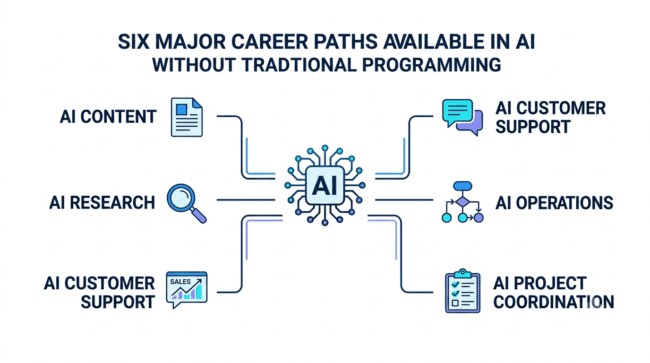
Why AI Jobs Without Coding Matter in 2026
AI is changing how companies create content, support customers, analyze information, automate repetitive work, and build internal processes.
That does not mean every new AI opportunity is a software-engineering job.
For beginners, the opportunity is often on the application side of AI: knowing how to use AI tools effectively, checking their output, improving workflows, organizing information, and helping businesses apply AI to everyday tasks.
This distinction matters. You do not need to become a machine-learning engineer to work around AI. However, you do need a marketable skill that AI can help you perform better.
The U.S. Bureau of Labor Statistics expects strong growth in several technology-related occupations during 2024–34, while also noting that AI adoption can affect different occupations in different ways.
The practical goal is therefore not simply to “get an AI job.” It is to become someone who can solve a business problem using AI.
[Internal Link: Best AI Tools to Make Money Online in 2026]
1. AI Trainer and AI Response Evaluator
AI systems need human feedback.
An AI trainer or evaluator may review AI-generated responses, compare different answers, identify errors, rate quality, or provide examples that help improve an AI system.
Useful skills:
- Strong written English
- Attention to detail
- Research ability
- Following detailed guidelines
- Critical thinking
- Subject-matter knowledge
Estimated earning range: Approximately $15–$40+ per hour, depending on the project, specialty, location, and contractor arrangement.
This can be a practical starting point because the work is often based more on judgment and communication than programming.
However, availability can be inconsistent. Some projects are temporary or have limited task volume.
2. AI Content Specialist
Businesses increasingly use AI to speed up content production, but raw AI output still needs human editing.
An AI content specialist can research topics, create outlines, generate drafts, fact-check information, improve readability, optimize content for search, and maintain a consistent brand voice.
The valuable skill is not simply “knowing ChatGPT.”
It is knowing how to turn an AI draft into useful, accurate, original content.
For example, a company might need someone to convert a product brief into:
- Blog posts
- Email sequences
- Social media content
- Product descriptions
- FAQs
- Customer education material
Estimated earning range: Roughly $20–$60+ per hour for freelance work, depending heavily on expertise and results.
3. AI Research Assistant
Research is another area where AI can increase productivity without eliminating the need for human judgment.
An AI research assistant may:
- Find relevant information.
- Organize sources.
- Summarize documents.
- Extract important facts.
- Compare competing products.
- Prepare research briefs.
- Flag information that needs verification.
The key skill is verification.
AI can produce convincing but incorrect information. A good research assistant knows when to question an answer and how to verify important claims using reliable sources.
This makes research ability more valuable, not less.
4. AI Customer Support Specialist
Customer service is becoming increasingly AI-assisted.
Companies may use AI chatbots for first-line questions while human workers handle complex cases, escalations, refunds, complaints, account problems, or unusual requests.
An AI-assisted support specialist may work with:
- AI chat systems
- Help-desk software
- Knowledge bases
- Customer relationship management tools
- Automated workflows
You may not need programming, but you do need communication skills.
Estimated earning range: Approximately $18–$35+ per hour for many entry-level to experienced positions, with actual compensation varying significantly by employer, location, schedule, and responsibilities.
[Internal Link: Best Work From Home Jobs for Introverts in the USA]
5. AI Operations Assistant
AI operations is a broad category.
The job may involve helping a company use AI tools consistently across everyday workflows.
Imagine a small company that wants to use AI for:
- Meeting summaries
- Email drafting
- Lead research
- Document organization
- Content production
- Internal knowledge management
Someone has to design the process, test it, document it, and monitor the results.
That person does not necessarily need to be a developer.
They need to understand how the business works and where AI can safely save time.
Estimated earning range: Approximately $25–$60+ per hour for freelance or contract work, depending on the complexity of the workflows and the person’s business experience.
6. No-Code AI Automation Specialist
This role sits between business operations and technology.
No-code automation platforms can connect different applications without requiring traditional software development.
For example:
Customer form → spreadsheet → AI classification → email notification → CRM
A beginner can learn these workflows using visual interfaces and AI assistants.
Important skills include:
- Workflow mapping
- Process documentation
- Basic logic
- Troubleshooting
- Prompt design
- Understanding business processes
You can begin with simple automations and gradually handle more complex systems.
Estimated freelance earning range: Around $30–$100+ per hour for specialized work. These are illustrative estimates, not guaranteed market rates.
7. AI Prompt Specialist
Prompting is often misunderstood.
Writing a few clever prompts is not necessarily a high-value career.
A stronger prompt specialist understands:
- Context
- Constraints
- Output formats
- Examples
- Evaluation criteria
- Failure modes
- Business objectives
Instead of saying:
“Write me a blog post.”
A professional might build a repeatable system that tells an AI tool what information to use, how to structure the output, what standards to follow, and how to check the result.
Estimated earning range: Approximately $20–$75+ per hour for freelance projects, depending on whether prompting is bundled with content, research, automation, or another specialized service.
8. AI Project Coordinator
AI projects need organization.
A project coordinator may track tasks, organize meetings, document requirements, manage deadlines, communicate with team members, and monitor deliverables.
AI tools can help with:
- Meeting notes
- Task summaries
- Project documentation
- Status reports
- Research
- Scheduling
- Draft communications
The human value is coordination and judgment.
This can be especially relevant for people coming from administration, operations, marketing, customer service, or project-management backgrounds.
9. AI Sales and Lead-Research Assistant
Sales teams spend significant time researching potential customers.
AI can help organize publicly available information, summarize company details, categorize prospects, and draft personalized outreach.
A human still needs to check the information and make sure outreach is relevant.
Possible services include:
- Prospect research
- Lead qualification
- CRM cleanup
- Sales-email drafting
- Competitive research
- Follow-up organization
Estimated earning range: Roughly $20–$50+ per hour, or project-based pricing depending on the service.
The strongest advantage comes from combining AI skills with sales knowledge.
10. AI Workflow Consultant for Small Businesses
This is a more advanced path, but it can become a valuable freelance service.
Instead of selling “AI,” sell a business outcome.
For example:
Weak offer:
“I provide AI services.”
Stronger offer:
“I help local businesses reduce repetitive administrative work by building AI-assisted workflows.”
You could analyze a company’s processes and identify tasks involving:
- Repetitive emails
- Data entry
- Document processing
- Customer questions
- Content production
- Lead management
- Reporting
Then recommend practical automation opportunities.
This approach requires more business knowledge, but it can create a stronger freelance positioning.
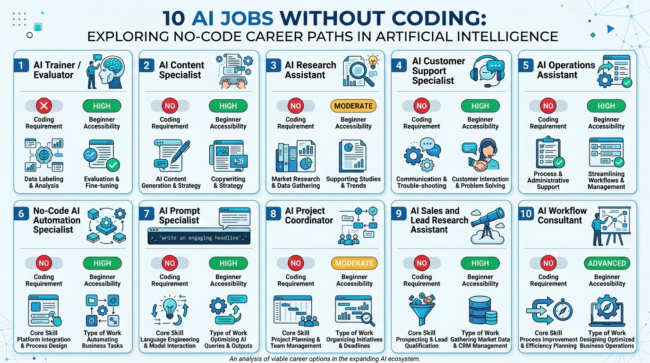
AI Jobs Without Coding: Quick Comparison
| Role | Coding Required? | Beginner Friendly? | Estimated Income Potential | Main Skill |
|---|---|---|---|---|
| AI Trainer/Evaluator | Usually no | Yes | $15–$40+/hr | Attention to detail |
| AI Content Specialist | No | Yes | $20–$60+/hr | Writing + editing |
| AI Research Assistant | No | Yes | $20–$50+/hr | Research |
| AI Support Specialist | No | Yes | $18–$35+/hr | Communication |
| AI Operations Assistant | Usually no | Moderate | $25–$60+/hr | Operations |
| No-Code Automation Specialist | Usually no | Moderate | $30–$100+/hr | Workflow design |
| Prompt Specialist | No | Moderate | $20–$75+/hr | Prompt design |
| AI Project Coordinator | No | Moderate | $25–$60+/hr | Organization |
| AI Sales Assistant | No | Yes | $20–$50+/hr | Sales research |
| AI Workflow Consultant | Usually no | Advanced | $40–$150+/hr | Business problem-solving |
Important: These are estimated ranges for planning purposes, not salary guarantees. Actual compensation can vary substantially by employer, contract type, experience, location, specialization, workload, and market conditions.
What Skills Do You Need for AI Jobs Without Coding?
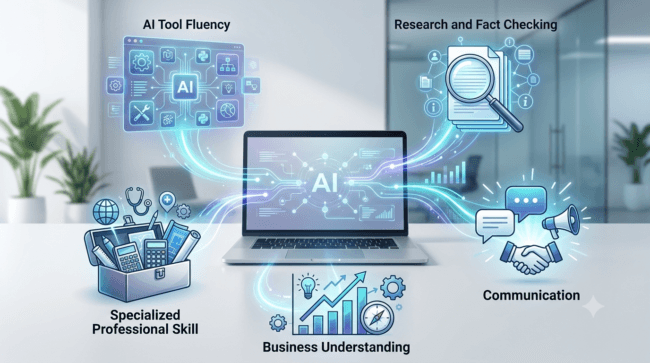
You do not need ten new skills at once.
Start with five:
1. AI Tool Fluency
Learn how to use one or two major AI assistants well.
Focus on:
- Clear instructions
- Context
- Examples
- Constraints
- Editing
- Verification
2. Research and Fact-Checking
Learn how to distinguish a useful AI response from an unsupported claim.
3. Communication
Clear writing is valuable across almost every nontechnical AI role.
4. Basic Business Understanding
Understand how companies make money, acquire customers, serve customers, and manage repetitive work.
5. One Specialized Skill
Combine AI with something you already know.
Examples:
AI + writing = AI content specialist
AI + customer service = AI support specialist
AI + spreadsheets = AI operations assistant
AI + marketing = AI marketing assistant
AI + administration = AI workflow coordinator
That combination is usually more defensible than trying to become a generic “AI expert.”
How to Get an AI Job Without Coding Experience
If you have no programming background, use a portfolio-first approach.
Step 1: Pick One Role
Do not apply to 20 unrelated AI categories.
Choose one.
For example:
AI Content Specialist
Step 2: Learn the Core Workflow
Spend several days learning how professionals actually perform the work.
Do not focus only on watching AI tutorials.
Create things.
Step 3: Build Three Portfolio Projects
For an AI content role, create:
- One researched article
- One content repurposing project
- One before-and-after AI editing example
For an AI operations role, create:
- One workflow map
- One automated process
- One process documentation sample
Step 4: Create a Simple Portfolio
Your portfolio can be a simple website or organized document.
Show:
- The problem
- Your process
- The tools used
- Your output
- What you improved
Step 5: Apply for Targeted Opportunities
Search for terms such as:
- AI trainer
- AI evaluator
- AI content specialist
- AI operations assistant
- AI project coordinator
- AI support specialist
- AI automation specialist
Also look for conventional job titles that now include AI responsibilities.
The Ugly Truth About AI Jobs Without Coding
AI jobs are real, but the internet often makes them sound easier than they are.
There Is No “Easy Money” Button
Knowing how to generate AI text does not automatically make you employable.
Companies pay for outcomes.
You need to demonstrate that you can save time, improve quality, increase productivity, solve a problem, or support revenue.
Some AI Work Is Contract-Based
AI training, evaluation, annotation, and similar projects can have variable workloads.
A platform may have plenty of tasks one week and fewer the next.
Do not build a personal financial plan around an assumed number of hours unless the work is actually guaranteed.
Watch for AI Job Scams
Be cautious if a supposed employer:
- Requires large upfront payments.
- Asks you to purchase expensive equipment from a specific seller.
- Requests sensitive information too early.
- Guarantees unusually high income for almost no work.
- Uses pressure to make you act immediately.
Verify the employer independently before accepting an opportunity.
Remember U.S. Tax Responsibilities
If you earn money as an independent contractor or self-employed worker, tax treatment can differ from ordinary employee wages.
The IRS says self-employed individuals generally report business income and may have self-employment and estimated-tax obligations. The IRS also states that net self-employment earnings of $400 or more generally trigger self-employment tax rules.
[External Link: IRS Self-Employed Individuals Tax Center]
Keep records of income and legitimate business expenses, and consult a qualified tax professional when your situation requires personalized advice.
30-Day Beginner Plan
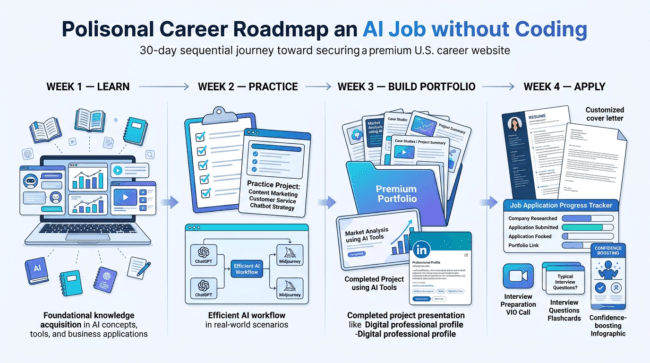
If you are starting from zero, use this simple schedule.
Days 1–5: Choose one AI job category and learn the basic workflow.
Days 6–10: Learn the major AI tools used for that workflow.
Days 11–15: Complete two realistic practice projects.
Days 16–20: Create your portfolio and professional profile.
Days 21–25: Find employers, agencies, freelance opportunities, and contract projects.
Days 26–30: Apply consistently, improve your portfolio, and track responses.
Your objective during the first month is not to become an AI expert.
It is to become credible enough to demonstrate one useful business skill.
FAQ: AI Jobs Without Coding
What are the best AI jobs without coding for beginners?
Beginner-friendly options include AI response evaluation, AI content assistance, research assistance, customer support, sales research, and some AI training projects. The right starting point depends on your existing skills. Someone with strong writing skills may have a different entry path from someone with customer-service or administrative experience.
How can I get an AI job without coding experience?
Start by choosing one nontechnical AI role, learning its workflow, and creating three portfolio examples. Then apply for targeted positions using role-specific keywords. Your portfolio should demonstrate what you can actually produce, rather than simply listing AI tools you have used.
Can I work in AI without programming?
Yes. AI work includes technical and nontechnical functions. Programming is important for many AI engineering roles, but other positions can focus on research, evaluation, operations, content, customer support, project coordination, or workflow implementation. You still need relevant skills and should not assume that “no coding” means “no training.”
What AI jobs can I do remotely without coding?
Remote possibilities can include AI evaluation, content production, research assistance, customer support, sales research, project coordination, and some workflow or automation work. Availability changes frequently, so check current job descriptions carefully and confirm whether a position is employee, freelance, or contract work.
How much can you make with AI jobs without coding?
Income varies widely. Entry-level contract tasks may pay around the lower end of the estimated ranges in this article, while specialized freelance services can command substantially more. Earnings depend on experience, niche, location, client demand, workload, and your ability to produce measurable business value.
Do AI jobs without coding require a degree?
Not always. Some employers require degrees, while others focus more heavily on experience, communication, portfolios, domain expertise, or practical assessments. Job requirements vary by employer and role. A strong portfolio can help demonstrate practical ability, but it does not replace formal credentials where an employer specifically requires them.
Are AI jobs without coding legitimate?
Yes, legitimate opportunities exist, but the category also attracts misleading advertisements and scams. Research the employer or platform, read the contract carefully, avoid upfront-payment demands, and verify the opportunity through an independent source before providing sensitive information or doing substantial unpaid work.
Quick-Start Checklist
- Choose one AI job category.
- Identify the skills required for that role.
- Learn one or two relevant AI tools.
- Complete three practical portfolio projects.
- Create a simple professional portfolio.
- Write a role-specific resume.
- Search for both AI-specific and AI-enabled job titles.
- Apply consistently instead of randomly.
- Track applications and interview results.
- Verify every employer or contractor opportunity.
- Keep records of freelance income and expenses.
- Review your tax obligations if you become self-employed.

Conclusion: Start With a Skill, Not Just AI
The biggest opportunity in AI jobs without coding is not learning how to press a button that generates an AI response.
It is learning how to use AI to perform a valuable task better, faster, or more consistently.
Start with one role. Build three proof-of-skill projects. Learn the workflow. Apply for targeted opportunities. Then expand into automation, operations, research, or consulting as your experience grows.
If you already have writing, marketing, customer service, research, sales, or administrative skills, you may not need to start your career from scratch. You can combine that existing skill with AI and build from there.
Internal/External Linking Placeholders
- Legitimate Data Entry Jobs From Home
- How to Make Money with Airbnb in 2026 USA Without Owning Property
- Best Work From Home Jobs for Introverts in the USA 2026 (No Phone, No Sales)
- Zero-Based Budgeting 2026 USA
- Best Budgeting Apps USA 2026
- Highest Paying Gig Economy Jobs in the USA 2026
- How to Start a Notion Template Business in 2026 USA
- Freelance Digital Skills That Pay 2026 USA
- Best Budgeting Tips for 2026 in USA
- Voiceover Jobs 2026 USA
- Virtual Bookkeeping Business 2026 USA
- Proofreading Jobs Online 2026 USA
- AI Data Annotation Jobs 2026 USA
- Online Transcription Jobs 2026 USA
- User Testing Jobs 2026 USA
- How to Become an AI Prompt Engineer in 2026 USA
- Best Secret Remote Job Boards 2026 USA
- Upwork for Beginners in 2026 USA
- Pinterest Affiliate Marketing in 2026 USA
- How to Start a Faceless YouTube Channel in 2026 USA
- How to Start Amazon KDP in 2026 USA
- How to Start Dropshipping in 2026 USA
- How to Create and Sell Online Courses in 2026 USA
Author Bio
“[Arvind Kumar] is a digital entrepreneurship researcher specializing in remote income models, online work, AI-assisted productivity, and practical side-hustle strategies for U.S. readers.”
Financial / Legal Earnings Disclaimer
This article is for informational and educational purposes only and does not constitute professional financial, tax, employment, or legal advice. Earnings estimates are illustrative and actual results may vary based on skills, experience, location, demand, employer, client, workload, and other factors.