
Disclaimer / Disclosure: This article is for informational and educational purposes only. AI training and prompt evaluation opportunities are often freelance or independent-contractor assignments, not guaranteed employment. Earnings, eligibility, project availability, payment methods, and working hours vary by platform, country, expertise, and client demand. We do not guarantee acceptance, a specific income, or continuous work. This website may contain affiliate links, which means we may earn a commission if you purchase a qualifying product or service through certain links, at no additional cost to you. Always review the original opportunity, compensation terms, privacy policy, and local tax requirements before accepting work.
Table of Contents
What Are AI Training and Prompt Evaluation Jobs?
Artificial intelligence training jobs are assignments in which people help improve AI systems by evaluating responses, labeling information, checking accuracy, writing examples, and providing feedback.
AI models can generate text, write code, summarize documents, and answer questions. However, their outputs are not always accurate, relevant, safe, or consistent. Human feedback helps identify weaknesses and improve model quality.
Many assignments can be completed from home using a computer and reliable internet access. Some require specialized qualifications, while others focus on general reasoning, writing, and communication.
Common job titles include:
- AI trainer
- AI response evaluator
- Prompt evaluator
- AI data annotator
- Search quality rater
- LLM evaluator
- AI writing reviewer
- Data labeling specialist
- AI coding evaluator
- AI safety reviewer
The responsibilities depend on the specific project.
What Does a Prompt Evaluator Actually Do?
A prompt evaluator examines how an AI model responds to instructions and determines whether its output meets defined quality standards.
For example, an AI assistant might receive this prompt:
“Explain three legitimate ways a college student can earn money online without paying an upfront fee.”
An evaluator may assess the response for:
- Accuracy: Are the recommendations real and factually correct?
- Relevance: Does the answer address the question?
- Completeness: Does it provide three useful options?
- Clarity: Is the explanation easy to understand?
- Safety: Does it avoid encouraging fraud or risky financial behavior?
- Instruction following: Does it respect the requested format?
- Evidence: Are important factual claims supported by reliable sources?
The evaluator may compare multiple responses, select the strongest one, identify mistakes, and explain the decision.

What Is AI Data Annotation?
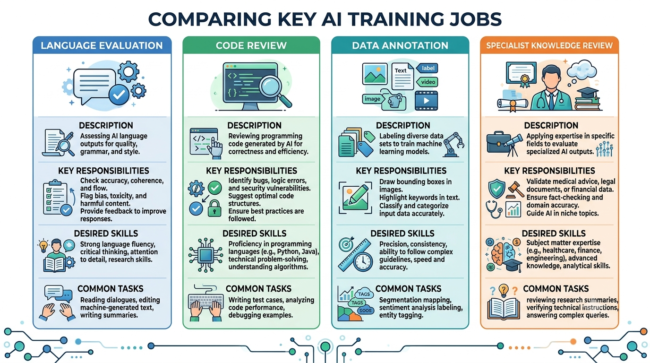
Data annotation involves labeling or organizing information so AI models can learn from examples.
Tasks may include:
- Categorizing text by topic or intent.
- Marking objects in photographs.
- Transcribing recorded speech.
- Identifying sentiment in customer reviews.
- Comparing chatbot responses.
- Checking whether statements are supported by evidence.
- Reviewing AI-generated code.
- Evaluating responses in different languages.
Some tasks are repetitive and straightforward. Others require specialized reasoning or professional knowledge.
Are These Jobs Different From Prompt Engineering?
Yes. Prompt engineering generally involves designing and refining instructions to help AI systems perform tasks effectively.
Prompt evaluation focuses on testing, judging, or comparing model outputs. AI training may involve both activities, but it also includes labeling data, generating examples, and providing structured feedback.
You do not necessarily need to be a machine learning engineer to become a prompt evaluator.
Best AI Training Jobs From Home in 2026–2027
The following platforms are useful starting points for job seekers interested in AI model training, prompt evaluation, and data annotation.
Platform availability, compensation, and eligibility can change. An open application does not guarantee that paid projects will be available.
1. Outlier AI
Best for: People with strong writing, analytical, coding, language, or academic skills.
Official website: https://outlier.ai/
Outlier connects qualified contributors with projects intended to improve generative AI models through human feedback.
Depending on the project, contributors may create prompts, evaluate responses, rank alternative answers, identify errors, or review subject-specific outputs.
Potential project categories include:
- General writing and reasoning.
- Mathematics and STEM.
- Computer programming.
- Multilingual response evaluation.
- Domain-specific expert review.
Skills and Qualifications
Requirements vary by opportunity. Outlier’s official FAQ describes education requirements that may include an associate degree, while specialist projects may require a bachelor’s degree, master’s degree, PhD, or relevant experience.
Typical expectations include:
- Strong written communication.
- Ability to follow detailed guidelines.
- Critical thinking and fact-checking.
- Relevant subject expertise for specialist work.
- Required identity verification.
- A résumé or professional profile where requested.
How Much Does Outlier Pay?
Outlier does not offer one universal hourly rate for every contributor.
For example, an advertised coding opportunity for Indian residents has listed rates of approximately $13.25–$27.50 per hour for Tier 1 coding experts. A separate US student-focused opportunity has advertised $15–$50 per hour.
These are examples of particular projects, not guaranteed rates for all applicants. Verify the current listing before applying.
Outlier’s published payment information describes weekly payments, with supported methods depending on the contributor and project.
Advantages
- Flexible freelance scheduling.
- Opportunities for qualified professionals and students.
- Exposure to AI model evaluation.
- Potentially higher-value work for specialists.
Limitations
- Competitive screening.
- Fluctuating project availability.
- Project-specific requirements.
- Country restrictions on some assignments.
How to apply: Visit the official website, review available opportunities, complete the required screening, and verify compensation and payment terms.
2. DataAnnotation.tech
Best for: Strong writers, critical thinkers, programmers, multilingual contributors, and subject-matter experts.
Official website: https://www.dataannotation.tech/
DataAnnotation offers work involving chatbot evaluation, writing, editing, prompt testing, response comparison, and specialist assignments.
Its official FAQ describes generalist, multilingual, coding, STEM, and professional tracks.
Skills and Qualifications
General projects emphasize:
- Strong English writing.
- Logical reasoning.
- Research and fact-checking.
- Clear explanations.
- Attention to detail.
Coding assignments may require Python, JavaScript, SQL, or other programming languages. STEM and professional projects may require advanced academic qualifications or relevant professional credentials.
The platform states that its generalist track expects a bachelor’s degree or equivalent real-world experience.
How Much Does DataAnnotation Pay?
The platform’s published FAQ has advertised starting rates of approximately:
- General projects: $25–$30+ per hour.
- Multilingual projects: $20+ per hour.
- Coding projects: $50–$100+ per hour.
- STEM and professional projects: $50–$100+ per hour.
These are advertised starting rates for relevant tracks, not guaranteed earnings. Rates, eligibility, and project availability can change.
The platform describes PayPal as a payment method, with processing timelines dependent on its payment procedures.
Advantages
- Generalist tasks do not necessarily require coding.
- Opportunities involving writing and reasoning.
- Specialist tracks for qualified applicants.
- Flexible scheduling for eligible contributors.
Limitations
- Completing an assessment does not guarantee acceptance.
- Project access may depend on qualifications and demand.
- Availability can differ by country.
How to apply: Use the official website and complete the appropriate assessment. The platform states that its Starter Assessment can only be taken once, so read the instructions carefully.
3. Scale AI
Best for: Data annotation specialists, technical reviewers, AI quality professionals, and applicants interested in AI operations roles.
Official website: https://scale.com/careers
Scale AI provides data infrastructure and services used to develop and evaluate AI systems.
Its work includes reinforcement learning from human feedback, semantic segmentation, image annotation, and other forms of data preparation.
Potential job categories include:
- AI data annotation.
- LLM evaluation and human feedback.
- Computer vision labeling.
- Quality assurance.
- AI operations.
- Technical and software engineering roles.
Not every role is a freelance work-from-home assignment. Some positions are full-time, and others may require a specific location.
Skills and Qualifications
Depending on the position, employers may look for:
- Strong reading comprehension.
- Accurate labeling and categorization.
- Knowledge of data quality standards.
- Computer vision or machine learning familiarity.
- Programming skills for technical positions.
- Ability to follow instructions and document decisions.
What About Pay?
Scale AI does not have a single public pay rate applicable to every annotation contributor. Compensation depends on the position, contract, location, and qualifications.
Check the advertised compensation for the exact role instead of assuming that rates for engineers or US-based contractors apply to entry-level annotation work elsewhere.
Advantages
- Exposure to AI data and model development.
- Opportunities in annotation and quality assurance.
- A mix of contract and career-oriented roles.
Limitations
- Some roles are location-restricted.
- Not all positions are suitable for beginners.
- Requirements and compensation vary by vacancy.
How to apply: Start with the official careers page and review the location, employment type, and qualification requirements.
4. Appen and CrowdGen
Best for: International applicants interested in language tasks, data collection, search evaluation, and AI training projects.
Official websites:
- Appen careers: https://www.appen.com/careers
- CrowdGen: https://crowdgen.com/experts/
CrowdGen is Appen’s contributor platform for project-based work supporting AI development.
Opportunities may involve evaluating search results, collecting data, reviewing content, transcribing speech, or completing language-specific tasks.
Skills and Qualifications
Depending on the assignment, applicants may need:
- Strong language comprehension.
- Knowledge of local culture and search behavior.
- Attention to detail.
- Ability to complete qualification tests.
- Reliable internet access.
- A suitable computer or mobile device.
Some projects are beginner-friendly, while others require specialized experience.
How Much Does CrowdGen Pay?
There is no single hourly rate applicable to every project. Compensation depends on the task, location, and payment structure.
Before accepting an assignment, check:
- The advertised rate.
- Whether payment is hourly or per task.
- Expected completion time.
- Whether training is paid.
- Payment method and withdrawal requirements.
CrowdGen states that project rates are visible before applying and that contributors do not need to pay a fee to join.
Advantages
- International and language-specific opportunities.
- Some assignments do not require technical experience.
- Potentially suitable for part-time work.
Limitations
- Project availability changes.
- Assessment requirements vary.
- Task-based earnings depend on available work and completion time.
How to apply: Register through the official CrowdGen website, identify suitable projects, complete required qualifications, and confirm the payment terms.
5. Other AI Evaluation and Data Annotation Opportunities
Beyond these platforms, look for relevant vacancies at established AI companies, remote-work marketplaces, and specialist language-service providers.
Potential categories include:
- AI search quality rating.
- Speech transcription and evaluation.
- Multilingual data annotation.
- AI safety evaluation.
- AI coding review.
- Model quality assurance.
- Machine learning data operations.
Verify the employer, application page, compensation structure, and working arrangement before applying.
AI Training Jobs Comparison Table
| Platform | Best suited for | Advertised pay information | Main consideration |
|---|---|---|---|
| Outlier AI | Writers, coders, specialists | Varies by project; examples include $13.25–$27.50/hour for an India coding project | Screening and variable task availability |
| DataAnnotation.tech | Writers, coders, STEM and professional experts | Advertised starting rates vary by track, from $20+ to $100+ | Eligibility and project access |
| Scale AI | Annotation, AI operations, technical roles | Depends on the specific vacancy or contract | Not all roles are freelance or remote |
| Appen CrowdGen | International and multilingual contributors | Rate shown for each project | Work volume and qualification requirements |
The figures above are examples of advertised rates, not guaranteed or directly comparable salaries.
Official references:
- Outlier: https://outlier.ai/faq
- DataAnnotation: https://www.dataannotation.tech/faqs
- Scale AI: https://scale.com/careers
- CrowdGen: https://crowdgen.com/experts/
Which Platform Should You Try First?
Choose based on your existing skills rather than the highest advertised rate.
- Strong writer: Explore general AI evaluation opportunities at Outlier and DataAnnotation.
- Programmer: Look for coding evaluator roles that match your actual programming skills.
- Multilingual applicant: Explore language-specific projects through CrowdGen and other established providers.
- Applicant seeking structured employment: Check Scale AI’s careers page for permanent and contract roles.
- Professional specialist: Look for assignments in finance, law, medicine, mathematics, or another relevant field.
Apply selectively to several suitable platforms rather than depending on one application.
How Much Can You Earn?
AI training income depends on the advertised rate, paid task availability, completion time, and whether the work is paid hourly or per task.
A high advertised rate does not necessarily translate into high monthly income if paid hours are limited.
Example Monthly Earnings
The following examples use different hourly rates and weekly paid hours. They are mathematical illustrations, not income promises.
| Advertised rate | Paid hours per week | Approximate monthly gross income |
|---|---|---|
| $10/hour | 5 | $217 |
| $15/hour | 10 | $650 |
| $25/hour | 10 | $1,083 |
| $30/hour | 15 | $1,950 |
| $50/hour | 10 | $2,167 |
Calculations use an average of 4.33 weeks per month and exclude taxes, fees, currency conversion, equipment expenses, and unpaid assessments.
For example:
$25 × 10 paid hours × 4.33 weeks = approximately $1,083 per month.
This assumes that 10 paid hours are actually available every week. If the project runs out of assignments, real earnings will be lower.
Hourly Pay Versus Task-Based Pay
Some platforms pay for time worked, while others compensate contributors per completed task.
Effective hourly rate = Total payment ÷ Total time spent.
Suppose a task pays $12 and takes 30 minutes. Your effective rate is $24 per hour before expenses.
If the same task takes 90 minutes, your effective rate falls to $8 per hour.
Check whether the platform pays for time spent reading instructions, researching, correcting work, and completing training.
Why Advertised Earnings Can Be Misleading
Several factors affect actual income:
- Qualification requirements.
- Task availability.
- Submission quality.
- Unpaid application and screening time.
- Country-specific rates.
- Taxes and expenses.
Avoid budgeting around an advertised maximum. Track actual paid hours and payments over several weeks before treating AI evaluation as dependable income.
Types of AI Training and Prompt Evaluation Work
1. AI Response Ranking
You receive two or more answers generated by an AI model and decide which is better.
You may evaluate factual accuracy, completeness, relevance, clarity, instruction following, and safety.
The key skill is applying the project’s criteria consistently.
2. Prompt Writing and Testing
Some projects ask contributors to create prompts that test a model’s capabilities.
Useful skills include:
- Writing clear instructions.
- Identifying edge cases.
- Testing different phrasings.
- Recognizing hallucinations.
- Defining measurable success criteria.
3. AI Fact-Checking
Fact-checking assignments require contributors to inspect model-generated statements and determine whether they are supported by reliable evidence.
Distinguish between verified facts, unverified claims, outdated information, contradictory evidence, and fabricated sources.
For current information, use reliable primary sources and follow the employer’s research rules.
4. AI Coding Evaluation
Coding evaluators examine generated code for correctness, efficiency, security, readability, and compliance with instructions.
Typical requirements include programming proficiency, understanding of algorithms, debugging ability, and clear technical explanations.
5. Multilingual AI Evaluation
Multilingual evaluators assess how AI systems understand and produce different languages.
Tasks can include translation review, grammar correction, localization, transcription, and cultural-context assessment.
6. AI Safety and Content Evaluation
Some projects require reviewers to identify harmful instructions, privacy violations, misleading statements, or inappropriate responses.
Read the project description and decide whether the subject matter is appropriate for you before accepting an assignment.
7. Image, Audio, and Video Annotation
Multimodal annotation may involve labeling objects in images, checking speech transcripts, identifying speakers, or describing visual content.
Requirements range from simple categorization to specialized annotation.
Skills and Qualifications You Need
You do not need to be an AI researcher to qualify for every AI training role. However, you need the skills required by the particular project.
Essential Skills for General Evaluators
Written communication: Explain why an answer is correct, incomplete, misleading, or irrelevant.
Critical thinking: Recognize errors that are not obvious from a quick reading.
Attention to detail: Follow scoring, formatting, and evidence instructions.
Research skills: Verify claims instead of assuming confident statements are accurate.
Consistency: Apply the same standards to similar tasks.
Time management: Complete assignments efficiently without sacrificing quality.
Digital literacy: Use browsers, spreadsheets, online work platforms, and productivity tools.
Technical Skills for Specialist Roles
Consider developing:
- Python or JavaScript.
- SQL and data handling.
- Basic statistics and probability.
- Software testing and debugging.
- Mathematics and logical reasoning.
- Machine learning fundamentals.
- Professional knowledge in fields such as finance, law, or biology.
These are not universal requirements. Focus on skills that repeatedly appear in the roles you want.
Do You Need a Degree?
It depends on the platform and role.
Some annotation tasks do not require a formal degree. Others may require a bachelor’s degree, an associate degree, equivalent experience, or professional qualifications.
Read the eligibility rules, including age, residency, education, and work authorization.
Do You Need to Buy an AI Course?
Not necessarily.
Start by learning to assess AI responses, conduct reliable research, write clear explanations, and recognize factual errors. Free documentation and practice exercises can help you build these skills.
Consider a paid course only if it teaches a relevant skill that you cannot reasonably learn through free resources. No course can guarantee acceptance by an AI training platform.
How to Apply for AI Training Jobs From Home
Step 1: Choose Your Strongest Skill Category
Start with one or two areas:
- General writing and reasoning.
- Programming.
- Mathematics or STEM.
- Translation and localization.
- Research and fact-checking.
- Data annotation.
Choose an area where you can demonstrate genuine competence.
Step 2: Prepare a Clear Résumé
Your résumé should emphasize relevant skills rather than simply stating that you are interested in AI.
Include writing or research experience, programming languages, relevant qualifications, language proficiency, document review experience, and familiarity with productivity tools.
Do not invent previous AI training experience. Transferable skills can be valuable when described accurately.
Step 3: Use Official Application Websites
Navigate to the company’s official website and find its careers, contributor, or project section.
Check the domain carefully. Avoid application links sent by unverified social media accounts or messaging groups.
Step 4: Check Your Eligibility
Before spending time on an assessment, verify:
- Country eligibility.
- Minimum age.
- Educational requirements.
- Language requirements.
- Accepted payment methods.
- Identity verification requirements.
- Whether the job is remote from your country.
- Whether your intended working arrangement is permitted.
Step 5: Complete the Assessment Carefully
Assessments may test writing, logic, programming, language proficiency, or instruction following.
Read the complete directions before answering. If the task provides a rubric, use it to evaluate every answer.
Accuracy, consistency, and clear reasoning are often central to evaluation work.
Step 6: Review the Contract and Payment Terms
Before starting paid assignments, understand the rate, task requirements, deadlines, and rules governing acceptable work.
Keep a record of completed assignments and payments. Do not begin work based on a vague promise that compensation will be decided later.
Step 7: Maintain Professional Standards
Follow confidentiality and data-handling rules. Do not share confidential prompts, client data, assessment answers, or internal project material publicly.
Ask for clarification through approved channels if an instruction is unclear.

How to Pass AI Evaluator Assessments
The assessment is often the first major hurdle. Practice the actual skills the job requires rather than memorizing generic AI terminology.
Practice With a Simple Evaluation Rubric
| Criterion | What to check |
|---|---|
| Accuracy | Are the factual claims correct? |
| Relevance | Does the answer address the question? |
| Completeness | Does it cover the requested points? |
| Instruction following | Does it respect the requested format and limits? |
| Clarity | Is it understandable and well organized? |
| Evidence | Are important claims adequately supported? |
Suppose one answer provides three relevant suggestions but includes an invented website, while another provides two verified suggestions and explains its limitations.
The better answer depends on the task’s scoring criteria. If accuracy is essential, the fabricated source is a serious defect. If the prompt explicitly requires three suggestions, the second answer is also incomplete.
A strong evaluator recognizes both issues instead of judging by writing style alone.
Common Assessment Mistakes
Avoid these errors:
- Skimming instructions.
- Choosing the longest answer automatically.
- Assuming polished writing means factual accuracy.
- Giving vague explanations.
- Ignoring word limits and formatting.
- Using unsupported claims.
- Rushing through a one-time assessment.
- Using unauthorized AI tools during an assessment.
When explaining a decision, identify the specific strength or error and connect it to the evaluation criteria. Follow the platform’s rules about external research and AI assistance.
AI Training Jobs for Beginners and Students
AI training can be attractive to beginners because some assignments prioritize reasoning, writing, and attention to detail over previous employment experience.
However, entry-level requirements do not guarantee access to paid work.
Can Students Apply?
Some platforms accept eligible students. Outlier publishes opportunities for university students, while individual projects may impose additional age, education, and residency requirements.
Other assignments may require a degree or professional experience.
Students must also comply with applicable visa and work authorization rules.
A Beginner’s Learning Plan
Week 1: Writing and reasoning
- Practice summarizing factual information.
- Compare two answers to the same question.
- Identify unsupported statements.
- Explain why one response is more useful.
Week 2: Research and accuracy
- Distinguish primary and secondary sources.
- Verify dates, names, numbers, and quotations.
- Identify outdated or contradictory information.
Week 3: Specialist skills
- Choose an area such as coding, mathematics, translation, or research.
- Complete practice exercises.
- Review common mistakes.
Week 4: Applications
- Prepare your résumé.
- Review eligibility requirements.
- Apply to suitable opportunities.
- Track assessments and responses.
This is a preparation framework, not a promise of acceptance within 30 days.
Can You Work Part-Time?
Many AI evaluation opportunities are flexible freelance assignments. However, deadlines, task availability, and working windows can differ.
Avoid assuming every platform allows unrestricted working hours.
AI Training Opportunities for International Applicants
International applicants need to pay particular attention to location restrictions.
A company may operate internationally without offering every project in every country. Payment availability, language requirements, tax documentation, and local work regulations can also affect eligibility.
What Should Applicants Outside the United States Know?
If you live in India or another country outside the United States, prioritize opportunities that explicitly accept residents of your country.
Before applying, check:
- Whether the listing names your country.
- Whether the advertised rate applies to your location.
- Whether your preferred payment method is supported.
- Whether tax or identity documentation is required.
- Whether the project requires a particular language or qualification.
A rate advertised for US contributors does not establish that the same rate is available to Indian applicants.
Should You Use a VPN to Access Restricted Work?
No. Do not misrepresent your location to qualify for a project.
Using a VPN to circumvent eligibility restrictions can violate platform rules, complicate identity verification, and create payment problems.
Apply using your genuine country of residence and accurate information.
How to Identify Legitimate Opportunities and Avoid Scams
The AI training job market attracts genuine employers, but scammers also exploit interest in remote work.
A trustworthy application process should clearly identify the platform, job requirements, compensation structure, and payment arrangements.
Warning Signs of an AI Job Scam
Be cautious if someone:
- Demands an upfront registration fee.
- Requires payment to unlock assignments.
- Promises guaranteed high daily earnings for simple tasks.
- Requests cryptocurrency deposits to release wages.
- Asks you to purchase mandatory training through an unofficial seller.
- Offers a job through an impersonated company account.
- Requests banking passwords, one-time passwords, or account recovery codes.
- Pressures you to install suspicious software.
- Requires recruitment of other people before you can earn.
- Promises payment without clear contract terms.
CrowdGen states that contributors do not have to pay to join its projects. DataAnnotation also states that it does not charge applicants for participation.
Verify every website and communication independently.
How to Verify a Job Offer
- Navigate to the company’s website independently.
- Find the vacancy or contributor opportunity on the official site.
- Confirm that the application domain is legitimate.
- Read the compensation and contractor terms.
- Check whether requested documents are necessary.
- Avoid sending sensitive documents to unverified recruiters.
- Save copies of contracts, payment terms, and relevant communications.
Identity verification can be legitimate on established platforms. The important distinction is whether you are completing the process through the verified official account and an authorized provider.

Understand the Independent Contractor Relationship
Many AI evaluation opportunities are freelance arrangements rather than permanent employment.
This can mean:
- No guaranteed monthly salary.
- No guaranteed minimum hours.
- No paid leave or employee benefits.
- Responsibility for applicable taxes.
- Variable project assignments.
- Contract-specific confidentiality obligations.
Read the agreement before accepting work. If you need predictable income, consider combining freelance AI work with a more stable employment option rather than relying on it immediately as your only income source.
A Practical 30-Day Action Plan
Days 1–7: Build Your Foundation
- Choose your strongest skill category.
- Read official job requirements.
- Practice evaluating AI-generated answers.
- Prepare a résumé highlighting relevant skills.
Days 8–14: Research Suitable Platforms
- Review Outlier, DataAnnotation, Scale AI, and CrowdGen.
- Check country eligibility and current vacancies.
- Compare payment arrangements.
- Apply to opportunities that match your skills.
Days 15–21: Complete Assessments
- Read each rubric carefully.
- Allow sufficient time for qualification tests.
- Track submitted applications and confirmation emails.
- Improve weak areas through additional practice.
Days 22–30: Evaluate Progress
- Follow up where an official process permits it.
- Review new suitable opportunities.
- Record assessment results and application status.
- Continue developing your strongest skill.
At the end of the month, evaluate what you have learned. If you have not received an offer, it does not necessarily mean that your skills are inadequate. A platform may have limited demand, strict eligibility rules, or more applicants than available assignments.
Continue applying selectively, improving relevant skills, and investigating other legitimate remote opportunities.
Frequently Asked Questions
1. What are the best AI training jobs from home in 2026–2027?
Outlier AI, DataAnnotation.tech, Scale AI, and Appen’s CrowdGen are useful starting points. The best option depends on your skills, location, qualifications, payment preferences, and current project availability.
2. Can I work as an AI trainer without experience?
Yes, some projects do not require previous AI employment. Applicants still need to meet the relevant skill, education, language, and assessment requirements.
3. Do AI training jobs pay real money?
Established platforms advertise paid opportunities, but compensation varies by project. Verify the official rate, payment terms, and eligibility before starting work.
4. How much do prompt evaluation jobs pay per hour?
Published rates vary widely. Some platforms advertise generalist assignments around $20–$30 or more per hour, while specialist coding and professional tracks may advertise higher rates. These figures are not universal.
5. Can I work for Outlier AI from India?
Outlier publishes opportunities specifically for Indian residents, including certain coding projects. Eligibility depends on the individual listing, qualifications, and available work.
6. Does DataAnnotation.tech accept beginners?
Its generalist work emphasizes writing and critical thinking rather than previous AI employment. However, the platform states that a bachelor’s degree or equivalent real-world experience is expected for its general track.
7. Do I need coding skills for AI evaluation jobs?
No. Some general evaluation assignments focus on writing, reasoning, research, and language. Coding skills are important for programming-specific projects.
8. Do I need a degree to become an AI evaluator?
Not for every role. Requirements range from no formal degree requirement to advanced academic or professional qualifications.
9. Can students do AI training work part-time?
Some platforms accept eligible students for flexible assignments. Students should verify age, education, residency, and work authorization requirements.
10. Are AI training jobs available worldwide?
No single platform guarantees worldwide access. Opportunities may be limited to selected countries, languages, or regions.
11. Do these jobs provide a fixed monthly salary?
Most contributor opportunities are project-based or freelance and may not provide a fixed salary or guaranteed hours.
12. Do I have to pay to join an AI training platform?
You should not pay an unofficial recruiter or a third party to unlock a job. Established platforms such as CrowdGen and DataAnnotation state that contributors do not pay to join their projects.
13. Can I use ChatGPT to complete AI evaluator assessments?
Follow the assessment’s rules. Some assessments prohibit outside AI assistance, and using it against those rules can disqualify you.
14. What equipment do I need?
Many text-based assignments require a computer, reliable internet access, and a suitable browser. Some tasks require a smartphone, webcam, or specialized software.
15. How long does it take to get accepted?
There is no universal timeline. Some platforms provide updates within days, while others take longer or may not contact unsuccessful applicants.
16. Can AI training become a full-time career?
It can be part of a broader career path, but freelance contributor work alone may not provide stable full-time income. Develop programming, data analysis, evaluation design, research, and AI quality assurance skills to expand your options.
Final Recommendations
AI training and prompt evaluation jobs can provide an opportunity to earn from home while developing practical experience in evaluating AI systems. However, the market is competitive, project availability fluctuates, and advertised rates are not guaranteed earnings.
For a practical starting strategy:
- Begin with Outlier and DataAnnotation if your strengths are writing, reasoning, or specialist knowledge.
- Explore CrowdGen for language-based and data annotation projects.
- Check Scale AI for relevant annotation, quality assurance, technical, and career-oriented positions.
- Verify location, pay, qualification, and payment requirements.
- Build your skills and track actual application results.
The most sustainable approach is to focus on genuine expertise, consistent evaluation quality, and careful research rather than promises of easy money.
Your next step: Visit the official websites listed in this guide, shortlist the opportunities that match your qualifications, and apply only when you meet the stated requirements.
Internal/External Linking Placeholders
- Legitimate Data Entry Jobs From Home
- AI Jobs Without Coding: 10 Roles to Start in 2026
- How to Make Money with Airbnb in 2026 USA Without Owning Property
- Best Work From Home Jobs for Introverts in the USA 2026 (No Phone, No Sales)
- Zero-Based Budgeting 2026 USA
- Best Budgeting Apps USA 2026
- Highest Paying Gig Economy Jobs in the USA 2026
- How to Start a Notion Template Business in 2026 USA
- Freelance Digital Skills That Pay 2026 USA
- Best Budgeting Tips for 2026 in USA
- Voiceover Jobs 2026 USA
- Virtual Bookkeeping Business 2026 USA
- Proofreading Jobs Online 2026 USA
- AI Data Annotation Jobs 2026 USA
- Online Transcription Jobs 2026 USA
- User Testing Jobs 2026 USA
- How to Become an AI Prompt Engineer in 2026 USA
- Best Secret Remote Job Boards 2026 USA
- Upwork for Beginners in 2026 USA
- Pinterest Affiliate Marketing in 2026 USA
- How to Start a Faceless YouTube Channel in 2026 USA
- How to Start Amazon KDP in 2026 USA
- How to Start Dropshipping in 2026 USA
- How to Create and Sell Online Courses in 2026 USA
Author Bio
“[Arvind Kumar] is a digital entrepreneurship researcher specializing in remote income models, online work, AI-assisted productivity, and practical side-hustle strategies for U.S. readers.”
Editorial and Earnings Disclaimer
Platform rates and eligibility criteria may change. Verify current information using official platform documentation before relying on any advertised rate. Income examples in this article are illustrative calculations and are not guarantees of employment or earnings.
This article may contain affiliate links. If you use affiliate links, ensure that they are clearly disclosed and comply with applicable advertising, consumer protection, and affiliate program requirements.